





Organoids hold great promise for human-relevant preclinical research, as disease models, and as a substitute for animal testing. Precisely for this reason, they are economically attractive as commercial products and are therefore often patented themselves. Whether their use without a license is permissible depends on three questions: Is research being conducted on the organoid itself, or does it serve merely as a tool? Is the focus on early drug discovery or on work already aimed at obtaining marketing authorization? And which law is applicable - German Patent Law (PatG), UPC law, or the national law of another EU member state?
Organoids Are Not a Common Good
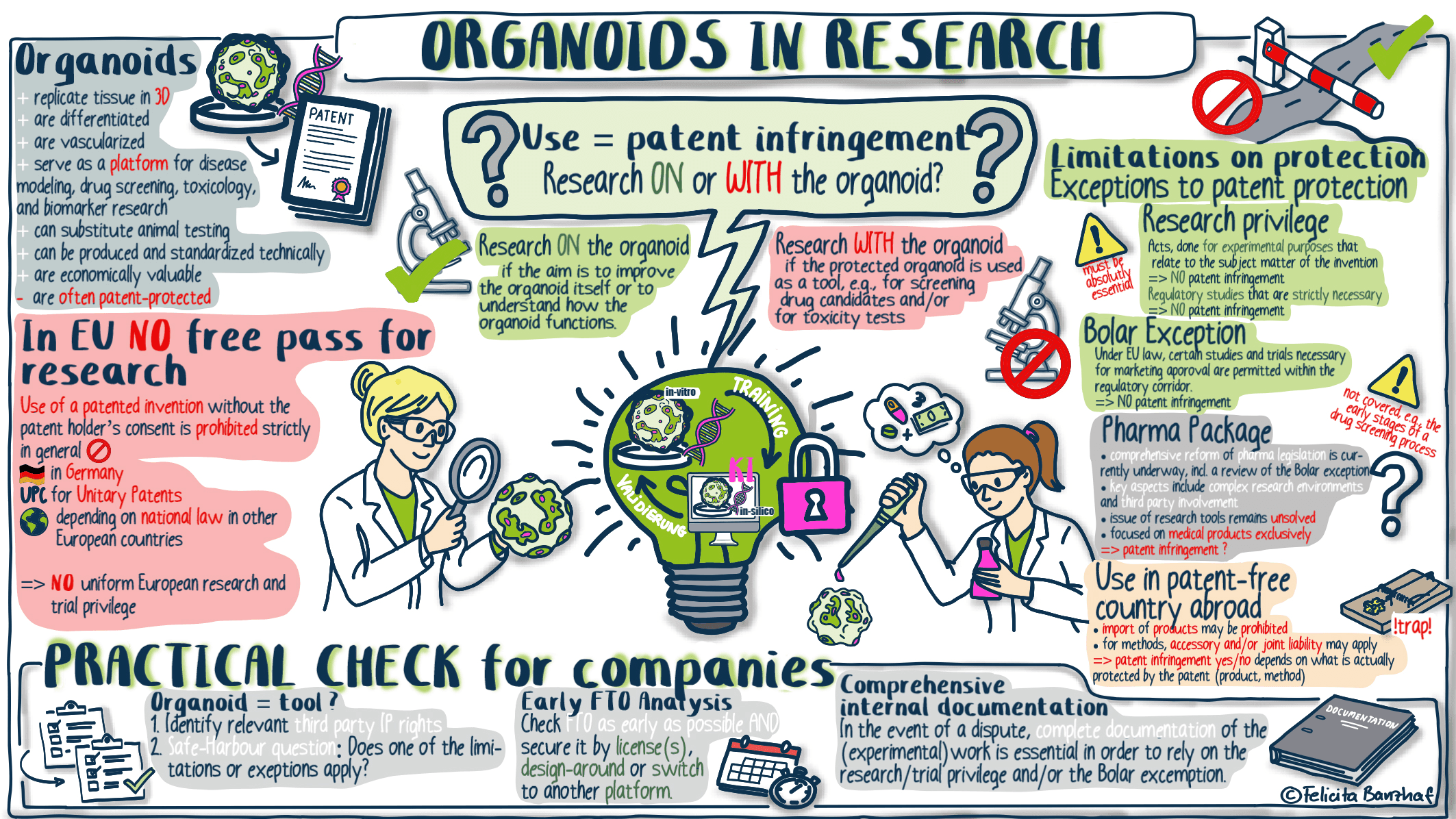
The enormous potential of organoids lies in the fact that they replicate human tissues in three dimensions and in a differentiated manner, with vascularization and organ-specific functionality. This makes it possible to gain insights that go beyond the capabilities of traditional 2D cell cultures. For biopharma companies, they are therefore attractive platforms for disease modeling, drug screening, toxicology, and biomarker research. At the same time, they align well with the 3R (Replace, Reduce, Refine) and NAM (New Approach Methodologies) principles - that is, with the political and regulatory goal of replacing or reducing animal testing. Ethical progress is real - but this does not automatically create freedom to operate under patent law.
On the contrary: precisely because organoids are technically producible, standardizable, and economically valuable, there is significant interest in securing a patent-protected monopoly for one’s own platform. Depending on the specific case, the organoid as a product, the manufacturing protocol, certain culture media, carrier systems, differentiation steps, or even the specific assay may be protected. Anyone working with an organoid platform therefore does not operate in a patent-free space, but potentially within the scope of one or more intellectual property rights.
Europe Does Not Recognize a General Free Pass for Research
The basic principle of patent law in Germany, as in the UPC system (Unified Patent Court), is strict: the use of a patented invention is, in principle, reserved for the patentee. The patentee may, in particular, prohibit any third party from manufacturing or using a patent-protected product or from applying a patented process (Section 9 PatG). In the UPC, the same basic principle applies to unitary patents and to those European patents enforced before the UPC (Art. 25 UPCA). For national patents in other EU member states, the respective national law also comes into play. Europe therefore does not recognize a uniform, general research privilege.
Many developers mistakenly assume that research must be permissible per se as long as no product is yet being sold. This is precisely what is incorrect under patent law. Patent law draws a much finer distinction between academic curiosity, preclinical development, and regulatory preparation. Therefore, in practice, the question of freedom to operate (FTO) must be seriously examined.
Research On Organoids vs. Research With Organoids
The most important general exception is the research or experimental privilege granted under patent law (Section 11(2) PatG; Art. 27(b) UPCA). Acts for experimental purposes, insofar as they relate to the subject matter of the patented invention, do not constitute patent infringement. If the functionality of a patented research tool is investigated with a view to potentially improving it, such research would be permitted.
German case law does not interpret this privilege unnecessarily narrowly. The German Federal Court of Justice (BGH) has emphasized (BGH – Klinische Versuche I und II1) that experiments on a patented subject matter may still be covered by the privilege - i.e., do not constitute patent infringement - even if the experimental results obtained later become commercially relevant. The decisive factor remains whether the acquisition of knowledge is directed at the invention itself. If the acquisition of knowledge is directed at determining whether a patented organoid model reliably replicates a disease, how stable it remains over passages, whether a new maturation protocol improves its predictive value, or for which research questions it is suitable, one may benefit from the statutory research privilege. Conversely, anyone who uses the same organoid solely for the purpose protected by the patent - such as drug candidate screening or toxicity testing - is not conducting research on the organoid. In that case, the organoid is being used improperly as a tool for one’s own purposes.
Conclusion on the research tool issue: Research using a patented tool, such as organoids, constitutes patent infringement, whereas research into the functionality of this tool may be free from such restrictions. The versatility of organoids promotes their increasing use and, at the same time, a higher density of potentially relevant intellectual property rights that must be observed.
The same applies today to the use of organoids in studies and experiments required to obtain marketing authorization under pharmaceutical law in the European Union or a drug approval in the Member States of the European Union or in third countries (Section 11(2b) of the German Patent Act). Within the framework of the 3Rs and NAM approaches, efforts are already underway to increasingly supplement or replace animal models and human trials with in vitro and, more recently, in silico approaches. It is to be expected that regulatory authorities will in the future push for a shift toward ethically less controversial models - organoids. However, the aforementioned alternatives must first be deemed to be mandatory in the regulatory framework for approval-related studies and practically irreplaceable for approval-related studies in order for these (organoids) to fall under the privilege of the approval procedures (Section 11(2b) PatG).
The Bolar Exemption in the Pre-Approval Phase
In addition to the research privilege, the Bolar exemption at the EU level plays a particularly significant role in drug development (Art. 10(6) of Directive 2001/83/EC). Under this provision, the necessary studies and trials, as well as the resulting practical requirements, are granted privileged status when conducted in connection with specific marketing authorization pathways. In the UPC jurisdiction, this is regulated by Art. 27(d) of the UPCA. Historically and systematically, Bolar is primarily aimed at the market entry of follow-on products (generics, biosimilars) after the expiration of patent protection.
Those seeking or optimizing a first-in-class candidate in early drug development typically do not operate within a regulatory framework. A patented tumor organoid used in this phase for screening or lead optimization is therefore difficult to classify under Bolar.
The situation may be different if an organoid-based assay were later to become “required” by regulators for dossier-relevant safety, comparative, or efficacy data. The statutory regulation in Germany (Section 11(2b) of the German Patent Act) is, at least in its wording, broader than the original EU legal formulation. However, the broader version has not yet been interpreted more broadly in case law. Therefore, the question of freedom to operate (FTO) in the context of exploratory platform work - formerly known as hit-to-lead projects or, more generally, feasibility studies - must be seriously examined.
Does the Pharma Package Provide Clarity?
The European Union is currently in the process of the most comprehensive reform of its pharmaceutical legislation. The so-called EU Pharma Package (not yet in force; current texts can be found at 2023/0132 (COD) and 2023/0131 (COD)) is intended, among other things, to modernize the regulatory framework for medicinal products and secure Europe’s competitiveness as a hub for pharmaceutical innovation.
The revised Bolar exemption and its interaction with increasingly complex research environments and third parties involved in pharmaceutical development is a central aspect of this. Nevertheless, the issue of research tools remains unresolved. The wording of the regulation focuses exclusively on medicinal products and the associated processes. However, particularly with regard to research tools, the distinction between the use of a patented invention as the subject of research and its use as a mere aid remains crucial; this rather argues against simply considering the use of patented research tools as falling under the Bolar exception.
Research in Patent-Free Countries: A dangerous trap
The complex legal situation surrounding patent-protected research tools within one’s own territory (the DACH region) and their applications - such as organoids - may tempt researchers to relocate their research work to a country where no patent protection exists and to import the results obtained there. Whether these activities are permitted or whether patent infringement applies domestically depends on the product claims of the patent. It depends not only on where a product is manufactured (for example, the expression of a protein), but also on where the patent-protected product is offered, placed on the market, used, or imported. The German Federal Court of Justice (BGH) has developed specific case law addressing the issue of patent infringement with foreign elements. For process and use claims (“use-claims”), the potential assertion of accessory liability and contributory infringement must also be considered, wherein the parties jointly carry out individual process steps and thereby commit the patent infringement. (BGH – Rohrschweißverschluss2 and Audiosignalcodierung 3).
What is essential here is the distinction between, on the one hand, the mere reproduction of a test result or a finding derived therefrom (BGH – Rezeptortyrosinkinase II4) - not patent-protected = no patent infringement - and, on the other hand, a technically defined data sequence as a direct, patent-protected product of a process (BGH – MPEG-2-Videosignalcodierung5), for which a patent infringement claim can be asserted.
The Chicken or the Egg – AI Model for Organoids vs. AI Model Based on Organoids
In light of the foregoing, it should be noted that to date, no court in the DACH region has published a decision regarding patent infringement through the use of patent-protected organoids. This also applies to patents targeting specialized AI models in the (bio)pharmaceutical industry. Like organoids, AI models are increasingly used research tools in drug discovery. Both aim to preselect a group of “hot hits” through highly specialized (virtual) humanized models, thereby streamlining resource-intensive development work, before time-consuming cell cultures or costly and ethically controversial animal testing is initiated. Organoids can be used in this context - as a reference or substitute for animal testing - to generate standardized training data. These can serve to build AI models of specific disease states, which are used for in-silico preselection. The predictions (output) obtained with the AI model can in turn be validated in vitro in a humanized organoid (see article “Will AI Save Biotech IP?” |transkript 1/2026). The challenge in this scenario is that, in the early drug development phase, the use of research tools takes place exclusively internally, and proving patent infringement is therefore subject to the challenge of providing evidence. While access to applications and regulatory documents is certainly available during the clinical phases, in the early drug development phases, only an inspection procedure—one that comes with substantial risks—may provide a remedy.
Practical check for biopharmaceutical companies
Rule of thumb: If the organoid is the central means to an end, third-party patents must be checked.
- Freedom-to-Operate (FTO)
A targeted license is often more economically sensible than a later patent infringement claim.
- Scope of protection
Organoid as a product, manufacturing process, culture medium, carrier, or assay.
- Jurisdiction
The German Patent Act (PatG), UPC proceedings, or the national law of another EU member state may lead to different assessments.
- Further development
If the goal is to gain insights into the organoid itself, the research privilege applies.
- New development
If the organoid is used to research the company’s own drug candidate, third-party rights must be observed.
- Project phase
Drug development and lead optimization are not equivalent to pre-approval comparative studies.
What Companies Should Do Now
For startups and growing biopharma companies, FTO analysis for the use of organoids should be on the agenda as early as possible. Anyone who discovers just before a financing round, a partnership, or the start of regulatory studies that the entire preclinical platform is based on a third-party intellectual property right has already lost strategically. This not only risks infringement proceedings but also delays in development and a weakened negotiating position.
A two-step approach is recommended. First, it should be clarified which intellectual property rights are relevant at all. Then comes the safe harbor question: Is this research on a patented subject matter, or does the protected organoid serve only as a tool, and is its use required by regulation? Those who answer these questions clearly often recognize early on whether a license, a workaround, or a platform change is the wiser option.
Given the constantly evolving legal framework, internal documentation is essential. Anyone wishing to invoke experimental use or the Bolar rule in a dispute should clearly document project objectives, study protocols, and regulatory reference points from the outset, so that, in the event of a dispute, a substantiated line of argument can exculpate them. Especially with organoids (in vitro) or virtual organoids (in-silico), the lines between scientific validation and commercial application quickly blur.
Conclusion: Ethical Progress Is No Substitute For a License
Organoids represent a preclinical approach that aims to be more human-relevant while reducing animal use, and they are scientifically attractive, ethically compatible, and economically valuable. From a patent law perspective, this results in a balancing act between the legal boundaries of research privilege, the Bolar exemption, pharmaceutical regulatory approval, and the simple use of a patented research tool. To avoid assertions of patent infringement, it should be determined early on whether a license is required, whether there is Freedom to Operate, or whether another legal exemption may apply.