



Second-Medical Indication Patents before the UPC- New Standards for Enforcement
Second-indication patents are common in the life sciences sector, legally recognized, but complex to enforce. With the decision of the Unified Patent Court (UPC) in Sanofi v. Amgen dated May 13, 2025 (UPC_CFI_505/2024), the UPC has now, for the first time, provided an in-depth examination of the infringement of such claims. The outcome is nuanced: Patent EP3536712B1 remained valid, but infringement was denied. For originator and generic manufacturers, this means a strategic realignment.
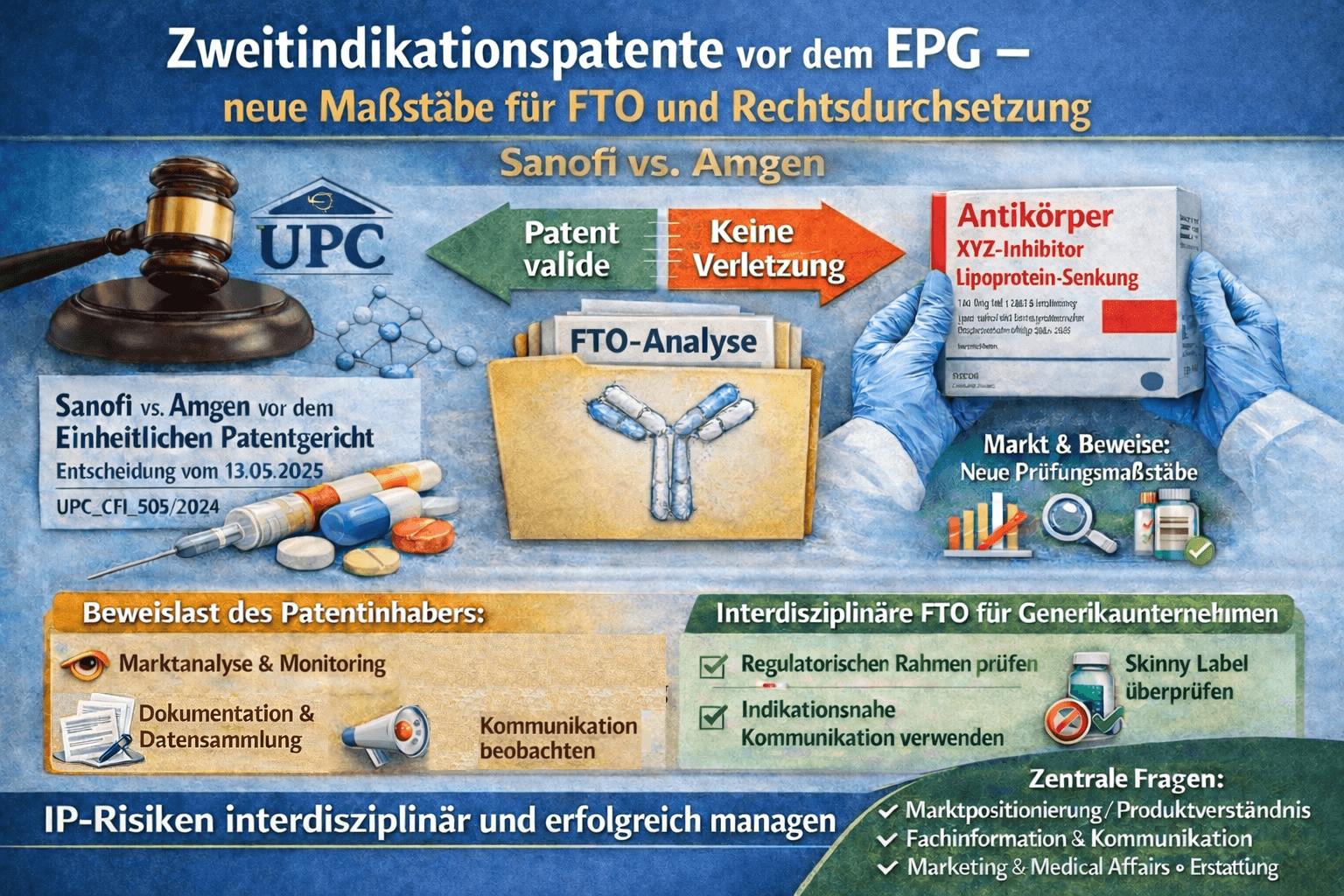
The central issue in the decision was the infringement of the purpose-bound substance claim regarding the use of a PCSK9 inhibitor to lower elevated lipoprotein(a) levels by the product Rephata®. The EPG formulated a new standard of examination that goes far beyond mere technical suitability: It is not sufficient that a therapeutic agent is objectively suitable for achieving the effect claimed in the patent. Rather, the decisive factor is whether the product is offered or marketed in such a way that it leads or can lead to the claimed therapeutic use - and whether the provider knew this or reasonably should have known it.
The Burden of Proof on the Originator
For originators, this decision means one thing above all: the enforcement of secondary indication patents is now data-driven. It is not merely a matter of whether an effect is described, but where it is described. A pharmacodynamic description in Section 5.1 of the product characteristics is not equivalent to a predefined therapeutic purpose in Section 4.1. Anyone asserting infringement must present specific circumstances regarding the market conduct of the alleged infringer. In doing so, the EPG effectively establishes a market-based infringement test.
Strategically, this means that originators should establish a strategic evidence framework early on. This includes the systematic monitoring of market communications, the evaluation of prescribing data, health economic analyses where applicable, and the documentation of indication-specific reimbursement practices. Without an empirical basis, an infringement lawsuit will be difficult to enforce in the future.
Between Claims and the Market
The decision also emphasizes the uniformity of claim interpretation for validity and infringement. There is no “broad” interpretation for the legal status and a “narrow” one for infringement - or vice versa. For secondary indication claims, the intended purpose is an integral part of the technical feature. If the purpose is not recognizably addressed in the market, there is no act of infringement - even if the pharmacological effect occurs.
This is not a shift away from patent law, but rather a clarification of the purpose of such claims: only the targeted use of the active ingredient is protected.
Interdisciplinary FTO required
For generic and biosimilar companies, this decision means that freedom-to-operate (FTO) analyses can no longer be limited to a purely patent-law-based review of claims. Furthermore, a “skinny label” does not provide automatic certainty. The key factor is that the company must not encourage the patented use nor knowingly accept it.
This makes FTO an interdisciplinary endeavor: patent law, regulatory affairs, market access, and compliance must work closely together. The drafting of the product information becomes a strategic IP issue.
Conclusion
For originator companies: Those who wish to strategically utilize second-medical indication patents must consider the subsequent burden of proof.
For generic drug companies: With careful regulatory and communication planning, market entries can be structured in a legally secure manner - even in the presence of existing second-medical-use patents.
Both parties must take into account the broader context:
- Market positioning of the product
communication regarding the use
- Content and structure of the Product Characteristics (SmPC)
distinction between indication and pharmacodynamic description
- Regulatory framework
mandatory vs. discretionary information
- Medical affairs and training materials
statements regarding therapeutic objectives
- Actual and expected prescribing practices
within the respective reimbursement system